One café or four hundred branches: the review problem is the same shape
89% of consumers expect a reply to their review, and half are put off by a templated one. That squeeze looks different at a café, a regional chain and an enterprise, but the underlying failure is identical.
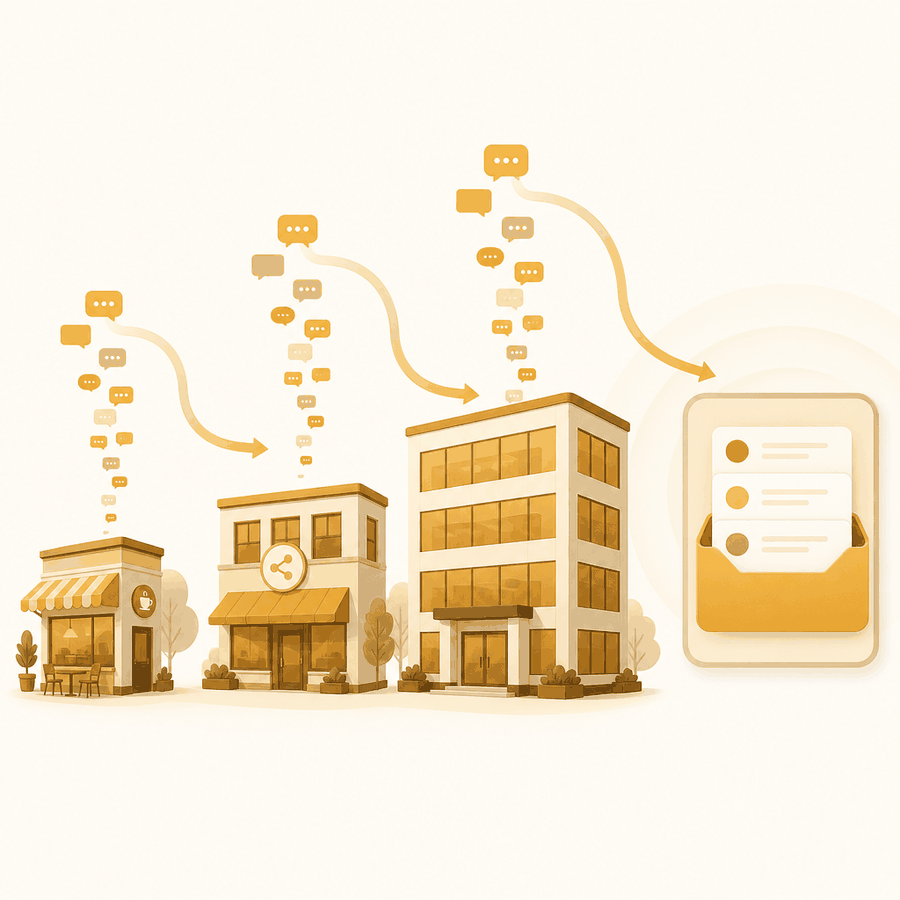
The squeeze
Two findings from BrightLocal's 2026 Local Consumer Review Survey, read together, describe an uncomfortable position.
The first: 89% of consumers expect a business to respond to their review. Nearly one in five expect it the same day, up from 6% a year earlier, and 81% expect to hear back within a week. Ignoring reviews is now visible behaviour. 42% of consumers say they are unlikely to use a business that leaves its reviews unanswered.
The second: generic or templated responses put off 50% of consumers, who read them as a sign of poor customer care.
So you must answer everything, quickly, and none of it can sound like it came off a shelf. That is a real operational problem, not a marketing problem, and it does not go away when you get bigger. It changes shape.
At one location, it is a memory problem
A café owner is not ignoring reviews out of indifference. They are closing the till at 11pm, and the review arrived at 3pm on a Tuesday while they were short-staffed on the floor.
The failure here is almost never attitude. It is that nobody logged in. Reviews live in a Google Business Profile dashboard and a Facebook page that get opened when someone remembers, which in practice means after something goes wrong. A one-star review from eleven days ago is discovered at the same moment as a compliment from three weeks ago, and both are now awkward to answer.
Small businesses also carry the most risk per review. Michael Luca's Harvard Business School study of Yelp ratings and Washington State revenue data found that a one-star increase in rating produced a 5 to 9% increase in revenue, and that the effect was concentrated in independent restaurants. Chains showed no measurable response. If you are one location, your rating is your reputation. If you are a chain, customers already know the brand and your rating moves less.
For this business the useful thing is not sophistication. It is that both sources land in one place, unanswered items are obvious, and drafting a reply takes seconds instead of being a task that gets postponed until it is embarrassing.
At twelve locations, it is a visibility problem
Something breaks between one site and a dozen, and it is rarely the writing.
Nobody has a single view. Each manager sees their own Google listing, head office sees a spreadsheet someone updates on Fridays, and the question "which of our sites is slipping" cannot be answered without asking twelve people. By the time a pattern is visible in a monthly report, it has been true for six weeks.
Voice fragments too. Twelve managers replying in twelve registers is not obviously worse than silence, but it is inconsistent in a way customers notice when they compare branches. The usual fix is a document of approved reply templates, which walks straight into the 50% problem: the templates are the thing consumers are learning to spot.
What actually helps at this size is comparison and delegation. One inbox across every location and source, so a branch drifting from 4.6 to 4.1 surfaces while it is still a fixable staffing issue. Roles, so a manager can draft and someone senior approves. And a shared voice that is genuinely shared, rather than five paragraphs of guidance nobody rereads.
At enterprise volume, it is an analysis problem
Past a certain point the reply is the easy half.
A few thousand reviews a month is a research dataset that nobody is reading. The star average barely moves, so it tells you nothing week to week. Somewhere inside that volume is the fact that complaints about wait times tripled in the north region after a rota change in June, and no human is going to find that by scrolling.
Enterprises usually respond by buying sentiment analysis and getting a dashboard of positive, neutral and negative, which mostly restates the star rating in different words. The useful question is not "how do customers feel" but "what specifically are they naming, how often, and is it getting worse". That means extracting topics from the text, tracking them over time, and being able to click a claim and read the reviews behind it.
The other enterprise-specific need is boring and non-negotiable: knowing that nothing gets published without a person approving it, and being able to show who approved what.
The part we had to be careful about
There is an obvious tension in building an AI tool for a job where half of consumers reject anything that sounds automated. We would rather address it directly than pretend it does not exist.
Three decisions follow from it.
Nothing posts itself. ReviewHive drafts, a person on your team reads and edits, and only then does it go out. This is not a setting we might relax later. A tool that can publish under your name without you is a tool that can damage you faster than you can notice.
The voice is learned from your own published replies, not from a generic idea of friendliness. Once your team has approved enough replies, ReviewHive describes how you actually write and uses that description as advice, ranked below any explicit instruction you have set. Your rules win. The observation is only ever an observation.
The draft is specific or it is useless. A reply that thanks the customer without referencing what they said is exactly the templated response that costs you half your readers. The model is given the review text and told to be concrete, and it is told, in the prompt, to avoid the vocabulary and punctuation that make writing read as machine-generated.
The point of the AI is not to remove the human. It is to remove the blank page, which is the thing that turns a two-minute task into a two-week delay.
What the reviews were telling you anyway
The last argument for taking this seriously is not reputational.
Reviews are unsolicited, specific, timestamped feedback from people who chose to spend money with you. Most businesses run surveys to get a weaker version of the same information. The reason reviews get treated as a marketing surface rather than an operations signal is that reading a thousand of them is genuinely hard, so nobody does it and the value stays theoretical.
Once the text is analysed into topics and tracked over time, the register changes. "Our rating dropped" is a problem you cannot act on. "Mentions of wait time doubled in the last six weeks and cluster on weekend evenings" is a rota change.
That is the same job at every size. A café owner is doing it in their head with twenty reviews. A four-hundred-site group cannot do it in anyone's head at all. The reason ReviewHive works for both is not that we built three products. It is that the underlying problem, feedback arriving faster than anyone can read it, only differs by a factor.
If you want to see what your own reviews have been saying, connect a source and let it read your history. The Basic plan is free, and no card is required.