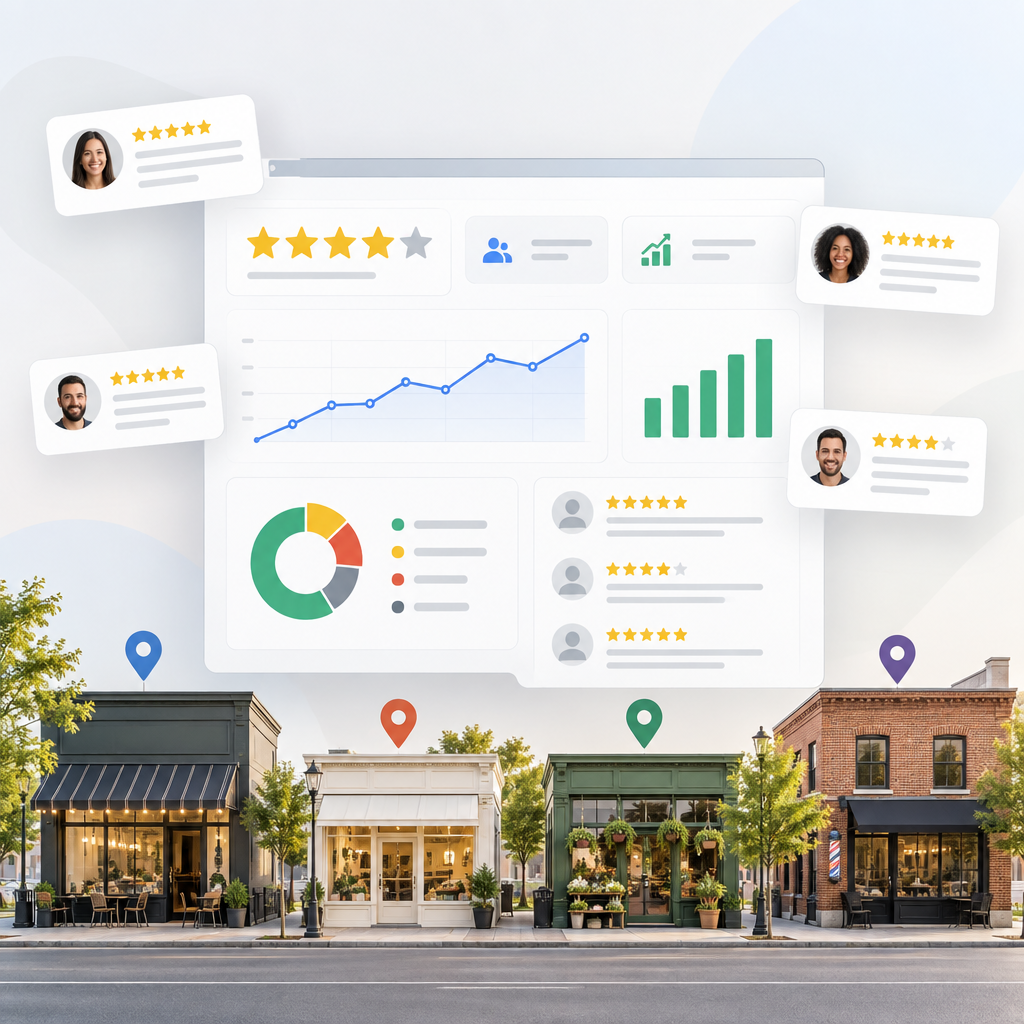
Yelp Data in ChatGPT: What SMBs Should Fix in Their Reviews Now
Yelp data in ChatGPT makes reviews part of AI local discovery. Here is how SMBs should audit profiles, reply faster, and track trends.

Yelp Data in ChatGPT: What SMBs Should Fix in Their Reviews Now
Yelp's OpenAI deal is one of the clearest signs yet that local reviews are moving from places customers visit into systems that answer, compare, and route demand. Search Engine Land reported in July 2026 that Yelp is licensing reviews, ratings, photos, and business information to OpenAI, giving ChatGPT access to real-time local recommendation data. That doesn't mean every ChatGPT answer is Yelp-powered. It does mean a review profile can influence a customer before they ever open a review site.
For SMB owners and marketers, the practical shift is simple: reputation data is becoming distribution data. Reviews are no longer only proof on your Google Business Profile, Yelp page, TripAdvisor listing, or Facebook page. They are raw material for AI answers, summaries, filters, and next-step actions.
AI local discovery is already behavior, not a theory
BrightLocal's 2026 Local Consumer Review Survey found that 97% of consumers read reviews for local businesses and that the average consumer uses six different review sites when choosing a business. The same survey found that use of ChatGPT and other generative AI tools for local recommendations rose from 6% in 2025 to 45% in 2026, making AI tools the third most common source for local recommendations behind Google and Facebook.
That is a big enough audience to treat AI discovery as part of local SEO planning, but not big enough to abandon the basics. Google still says local results are mainly based on relevance, distance, and prominence, and it names review count and positive ratings as signals that can help local ranking. A business with weak Google reviews and neglected Yelp reviews is not solving AI visibility by publishing a few blog posts. The review record itself needs work.
Pew Research Center's 2026 AI survey adds useful context. It found that 49% of U.S. adults use AI chatbots, and 44% use ChatGPT specifically. Adults under 50 are much more likely than older adults to use chatbots to search for information. If your customers skew younger, urban, professional, or research-heavy, assume some of their comparison shopping is already happening in chat interfaces.
Yelp is turning reviews into answer fuel
Yelp is not only sending data to other AI platforms. In April 2026, Yelp announced an expanded Yelp Assistant across categories, powered by hundreds of millions of reviews, photos, and business details. The product can handle specific local requests and show user-generated content to support recommendations. Yelp also described action paths such as reservations, ordering, quote requests, and appointment booking.
That pattern matters beyond Yelp. AI products are getting better at compressing the path from search to decision. A consumer may ask for a dog-friendly cafe with outdoor seating, a contractor who can handle a small job this week, or a salon with consistent praise for curly hair. The AI answer needs structured facts, current listings, review themes, photos, ratings, and signs of responsiveness.
This is where a thin review presence becomes expensive. If your latest Yelp review is two years old, your Google replies are generic, and your Facebook recommendations tell a different story from your TripAdvisor reviews, an AI system has less reliable evidence to work with. A competitor with fresh, consistent, specific feedback may look safer to recommend.
Fix the review signals that AI can actually read
Start with completeness. Your hours, categories, services, booking links, phone number, service area, photos, and menu or product details should match across major profiles. Google says complete and detailed Business Profile information helps it understand relevance, and the same logic applies when AI systems pull from structured business data.
Next, look for review themes, not only average stars. BrightLocal found that the most important review factor for consumers is whether a review is backed up by other reviews with similar sentiment. In practice, that means repeated praise for fast appointments, careful staff, transparent pricing, clean rooms, or accurate estimates is more persuasive than one glowing testimonial. It also means repeated complaints should be treated as operational data, not just reputation risk.
Then check recency. BrightLocal reported that 74% of consumers only care about reviews written in the last three months, and 44% named reviews from the last month as an important factor. Build review requests into real workflows, after appointments, completed jobs, pickup orders, support resolutions, and repeat visits. Keep it compliant: Google says incentives for reviews, review changes, or negative review removal are prohibited. Ask every customer consistently, don't pay for praise.
Responses are now public proof of service quality
Review replies used to feel like housekeeping. They now read like a customer service archive. BrightLocal found that 89% of consumers expect business owners to respond to reviews, 81% expect a response within a week, and 50% are unlikely to choose a business when replies look generic or templated.
Google's own guidance lines up with that. It recommends professional, polite, short, relevant replies, and says businesses should avoid using the same thank-you response for everyone. For negative reviews, Google recommends protecting privacy, acknowledging specific feedback, explaining limitations honestly, and responding in a timely manner.
The goal is not to write long essays. A strong reply usually does four things: thanks the reviewer, references the actual issue or compliment, states the next step if one is needed, and signs off with a human role or name. AI assistance can speed that up, but someone should still check tone, facts, privacy, and promises before publishing.
ReviewHive helps here by bringing reviews from multiple platforms into one dashboard, showing rating and sentiment trends, and drafting AI-assisted replies your team can edit quickly. That matters when the same customer story may influence Google searchers, Yelp users, and AI-powered local recommendations.
Build a weekly reputation check for AI-era local SEO
A workable routine doesn't need to be complex. Each week, review new feedback across Google, Yelp, Facebook, industry sites, and niche directories. Tag recurring themes. Reply to every legitimate review. Flag possible policy violations without arguing publicly. Compare rating trends by platform, because a strong Google profile can hide a deteriorating Yelp or TripAdvisor pattern.
Once a month, search your business category the way a customer would: in Google, Maps, Yelp, and at least one AI assistant. Use prompts with real buying criteria, such as emergency plumber open tonight, best med spa for first-timers, or family restaurant with gluten-free options. Record which competitors appear, what review evidence is cited, and whether your business information is accurate.
You can't control every AI answer. You can control whether your review footprint is fresh, consistent, specific, and responsibly answered. That is the part worth managing.
ReviewHive gives SMB teams one place to monitor that work, spot reputation trends early, and respond faster without sounding canned. If AI discovery is going to quote, summarize, and compare your customer feedback, make sure the underlying review record is ready.
Sources
- BrightLocal: Local Consumer Review Survey 2026: Star Ratings Keep Rising, Old Reviews Don't Cut It
- Search Engine Land: ChatGPT gains access to Yelp reviews, ratings, and photos
- Yelp: Yelp Launches the New Yelp Assistant, Transforming Local Discovery from Search to Answers and Actions
- Google Business Profile Help: Tips to improve your local ranking on Google
- Google Business Profile Help: Tips to get more reviews
- Pew Research Center: How opinions and use of AI differ by age